27Gn800 B Review: Real User Experience After 3 Months
I remember the day I finally hit the "order" button on the LG UltraGear 27GN800-B. I had been oscillating for weeks between various 1440p monitors, drowning in spec sheets and YouTube review comparisons. As someone who splits my time equally between competitive shooters like Valorant and immersive single-player experiences like Cyberpunk 2077, I needed a panel that didn't force me to compromise on either speed or visual fidelity. Now, after ninety days of daily use for both work and play, I feel like I finally have the full picture of what this monitor is—and what it isn't.
Establishing the Baseline: Why I Chose the 27GN800-B
Before I dive into my daily findings, I think it's important to explain why I chose this specific model. In the crowded market of 27-inch 1440p displays, the 27GN800-B often sits in a curious spot. It is frequently marketed as the more "budget-friendly" sibling to the legendary 27GP850-B. In my experience looking for a new display, I noticed that the primary difference on paper was the stand and the lack of a Nano-IPS layer. I was skeptical. Would the standard IPS panel look washed out compared to its more expensive counterparts? Would the 144Hz refresh rate feel sluggish compared to the 165Hz or 180Hz options starting to dominate the mid-range? I decided to take the risk, primarily because I preferred a flat screen over the curved VA panels that usually occupy this price bracket.
The first thing I noticed when unboxing the unit was the build quality. It is unmistakably LG. The plastic feels dense and high-quality, though the design language is very much "gamer-centric" with the red accents on the back. However, since the monitor faces the wall, I hardly notice the aesthetics. What I did notice immediately—and what initially bothered me—was the stand. It is a simple tilt-only stand with no height adjustment. I knew this going in, but seeing it on my desk made me realize how much I value ergonomics. I ended up mounting it on a VESA arm within the first week, which I strongly recommend to anyone considering this model.
The Performance: Gaming and Response Times
Performance was the main reason I bought this monitor, and after three months, this is where the 27GN800-B shines most brightly. I am particularly sensitive to motion blur. On my previous VA panel, "smearing" was a constant annoyance, especially in dark scenes where moving objects would leave a ghostly trail behind them. Moving to this IPS panel felt like getting a new prescription for my glasses. The clarity in motion is, in my experience, exceptional for a display in this price range.
I've spent about 200 hours on this monitor playing fast-paced games. What I found was that the "Fast" response time setting is the sweet spot. LG provides an "Faster" setting, but after testing for several hours in different lighting conditions, I noticed significant inverse ghosting (overshoot). The pixels were firing so fast they were overshooting their target color, leading to a weird glow around moving edges. Switching back to "Fast" solved this entirely, providing a crisp image without the artifacts. In Valorant, tracking heads while counter-strafing felt infinitely more reliable than on my old 1080p 60Hz display, or even the budget 144Hz VA panels I’ve tried in the past.
One thing that surprised me was how effective the G-Sync compatibility is. Even though this isn't a "Native G-Sync" monitor with a dedicated hardware module, I haven't experienced a single instance of screen tearing or flickering. My PC fluctuates between 90 and 140 FPS in modern AAA titles, and the 27GN800-B handles these transitions seamlessly. It makes the gameplay feel much smoother than the raw frame rate would suggest.
Image Quality: The IPS Advantage
When I wasn't clicking heads, I used the monitor for watching 4K YouTube content and editing some home photos. I was worried that "standard" IPS would lack vibrance. I was wrong. The color reproduction out of the box was surprisingly accurate, though I found the "Gamer 1" preset a bit too heavy on the greens. After spending an afternoon tweaking the RGB values and brightness, I achieved a look that felt natural and punchy. The sRGB coverage is rated at 99%, and in my experience, it covers that range faithfully. Red colors, in particular, look deeply saturated without looking "neon" or artificial.
Shop the latest Electronics picks on Amazon.
View Offers →However, it wouldn't be an honest review if I didn't mention the contrast. This is the inherent weakness of almost all IPS panels, and the 27GN800-B is no exception. After three months of use, I've noticed that in a dark room, the "blacks" are never truly black; they are a dark silvery gray. When playing games with dark, atmospheric settings like Resident Evil Village or Elden Ring at night, I noticed the "IPS Glow" in the corners. It isn't a dealbreaker for me, as I usually keep a lamp on in my office, but if you are a "cave gamer" who plays in total darkness, you will definitely notice it. The glow is most prominent in the bottom-left corner of my specific unit, though this is often a "panel lottery" issue where some units are better than others.
Day-to-Day Productivity and Text Clarity
Since I work from home, I spend about eight hours a day looking at spreadsheets, emails, and code. This is where the 1440p (QHD) resolution at 27 inches really pays off. For those still on 1080p, the jump in pixel density is massive. Text is incredibly sharp, and I can fit two windows side-by-side comfortably without things feeling cramped. The matte coating on the screen is very effective at diffusing reflections from the window behind my desk. I noticed that even on sunny afternoons, I didn't have to strain my eyes to read text, provided I boosted the brightness to about 80%.
One minor disappointment I encounter daily is the lack of USB ports. Many modern monitors act as a hub for your mouse and keyboard, but the 27GN800-B is strictly a display device. It has two HDMI ports, one DisplayPort, and a headphone jack. That's it. If you're someone who likes to keep their desk cables tidy by plugging peripherals into the monitor, you'll be disappointed here. I’ve had to run several long cables back to my PC tower, which adds to the clutter under my desk.
The Comparison: How It Holds Up
I often get asked if this monitor is better than its competitors from brands like Gigabyte or Asus. After testing for three months and comparing my findings with friends who own similar displays, I've put together a quick comparison of how the 27GN800-B stacks up against the general market expectations for this category.
| Feature | LG 27GN800-B | Typical Budget 1440p Monitor | Mid-Range 1440p Monitor |
|---|---|---|---|
| Panel Type | IPS (Fast) | VA (Slow) or Standard IPS | Nano-IPS / Fast IPS |
| Motion Clarity | Excellent | Poor to Average | Excellent |
| Contrast Ratio | ~1000:1 (Average) | ~3000:1 (Better) | ~1000:1 (Average) |
| Stand Adjustability | Tilt Only | Varies | Height, Tilt, Swivel, Pivot |
| Color Accuracy | High (99% sRGB) | Varies | Very High (DCI-P3 focus) |
Pros and Cons: The Three-Month Verdict
After ninety days of living with this monitor, I can summarize my feelings quite clearly. It is a performance-first machine that cuts corners in physical ergonomics to deliver a premium internal panel experience at a lower cost.
What I Loved (The Pros)
- Motion Handling: This is a 144Hz monitor that actually feels like 144Hz. There is virtually no ghosting when using the Fast overdrive setting, making it a dream for FPS players.
- Resolution Sweet Spot: 27 inches at 1440p is the perfect balance for my desk. It provides enough space for productivity without requiring a massive desk or a top-tier GPU to drive.
- Consistent IPS Colors: Unlike VA panels I've used, the colors don't shift when I move my head slightly to the left or right. The viewing angles are fantastic for sharing a screen with someone else.
- Menu Navigation: LG’s "joystick" control at the bottom center is the best in the business. Navigating the On-Screen Display (OSD) is fast and intuitive. I never find myself fumbling with five different buttons on the side.
- G-Sync Compatibility: It works exactly as advertised with my NVIDIA card, eliminating tearing without adding noticeable input lag.
What Bothered Me (The Cons)
- The Stand: I cannot stress this enough—the included stand is inadequate. It sits very low, and the lack of height adjustment meant I was hunching over until I bought a VESA mount.
- IPS Glow and Contrast: If you enjoy playing horror games or watching movies in a dark room, the glow in the corners can be distracting. The "blacks" just aren't deep enough for true cinematic immersion.
- HDR is "Fake": The monitor supports HDR10, but with only 350 nits of peak brightness and no local dimming, it doesn't look good. In my experience, turning on HDR made most games look washed out and "grayish." I’ve kept it off for 95% of my time.
- Lack of Ports: No USB hub functionality is a missed opportunity for a monitor that could otherwise be a great productivity center.
- External Power Brick: The monitor uses a proprietary power brick rather than a standard internal power supply. It’s one more thing to hide behind the furniture.
A Real-World Buying Guide: Who Should Get This?
In my experience using the 27GN800-B, I've realized that it isn't the "best" monitor for everyone, but it is the "right" monitor for a very specific type of person. If you are debating whether to pull the trigger, here is my honest advice based on three months of testing.
I would recommend this monitor if you are a gamer first and a media consumer second. If your primary games are competitive titles—Call of Duty, Apex Legends, League of Legends—the speed of this panel is its greatest asset. You are getting the same motion performance as monitors that cost $100 more, simply because you are giving up the fancy stand and the USB ports. It is also an excellent choice for a budget-conscious office worker who wants the sharpness of 1440p but also wants to play games in their off-hours.
Find top-rated Electronics products at great prices.
View Offers →On the other hand, I would suggest looking elsewhere if you are a professional colorist or if you mostly use your monitor for late-night movie viewing in the dark. The contrast ratio will frustrate you over time. Furthermore, if you do not plan on buying a separate monitor arm, you should really consider if you can live with a monitor that sits low on your desk. I measured it, and the distance from the bottom bezel to the desk is only about 4 inches, which isn't ideal for long-term spinal health.
One final tip for new owners: I noticed that out of the box, the "Power Save Mode" is enabled. This caused the brightness to fluctuate randomly based on what was on the screen. It was very annoying when switching between a dark website and a white spreadsheet. I found that turning this off in the OSD settings immediately solved the problem and made the experience much more consistent.
One Year Later Perspective? No, Just Three Months
They say the "honeymoon phase" for tech ends after about thirty days. That’s when you stop noticing the new pixels and start noticing the annoying quirks. After getting past that phase, I can say that the LG 27GN800-B is still a joy to use. I no longer notice the IPS glow during my daily work, and I’ve become accustomed to the exceptional clarity in my games. Every time I go back to a standard 1080p monitor at work, I am reminded of how much better my experience at home is.
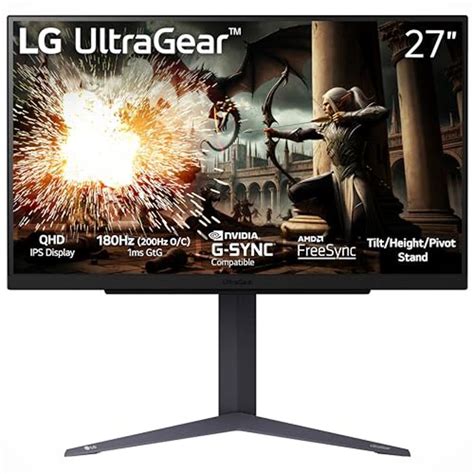
I was surprised by how much the 144Hz limit didn't matter. While the 27GP850-B offers 180Hz, I found that in most modern titles, I’m rarely hitting 180 FPS at 1440p anyway. Staying at 144Hz feels like the perfect ceiling for the current generation of mid-range hardware. It provides that "buttery" feel without being overkill for the GPU.
Conclusion
My three-month journey with the 27GN800-B has been one of managed expectations and eventual satisfaction. I went into the purchase fearing that the "budget" label would mean a substandard visual experience. What I found was that LG concentrated all the value into the panel itself. While the package around the screen—the stand and the extra features—is bare-bones, the actual glass you stare at every day is phenomenal for the price. If you already have a monitor arm, or are willing to buy one, and you want a fast, color-accurate 1440p screen without the "Ultra-Premium" price tag, this monitor is an easy recommendation. It isn't perfect, especially in the dark, but in the bright light of daily gaming and work, it has proven itself to be a reliable and high-performing companion.