K65 Lux Rgb Review: Real User Experience After 3 Months
There is a specific kind of anxiety that comes with downsizing your desk setup. For years, I was a devotee of the full-sized mechanical keyboard life, convinced that I couldn't survive without a dedicated number pad for spreadsheets and quick calculations. However, as my desk became increasingly cluttered with audio interfaces, external drives, and oversized mousepads, my mouse-hand kept bumping into the side of my keyboard during intense gaming sessions. I knew I needed a change, but I wasn't willing to sacrifice build quality or that tactile satisfaction I’ve grown accustomed to. That’s what led me to pick up the K65 Lux Rgb three months ago. After ninety days of daily driving this tenkeyless (TKL) board for both professional writing and competitive gaming, I’ve moved past the "honeymoon phase" and into the reality of what it’s like to own this piece of hardware.
Initial Transition and Desktop Real Estate
The first thing I noticed when I pulled the K65 Lux Rgb out of the box was the weight. For a compact keyboard, it has a surprising amount of heft thanks to the aircraft-grade anodized brushed aluminum frame. In my experience, many TKL boards feel like plastic toys because manufacturers use the smaller form factor as an excuse to cut corners on materials. Corsair didn't do that here. I’ve been using this for everything from 4,000-word articles to five-hour sessions of fast-paced shooters, and the stability of the chassis is one of its strongest selling points. It does not flex, and it does not slide around my desk, even when I’m typing with a heavy hand.
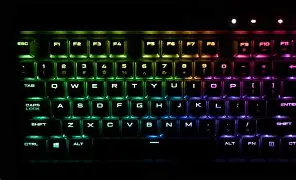
Setting it up was a bit of a mixed bag for me. While I appreciated the "plug and play" nature of the basic functions, I quickly realized that to get the most out of the RGB lighting and the macro settings, I had to dive into the Corsair Utility Engine (iCUE) software. I was surprised by how much desk space I actually regained. By removing that extra four inches of the number pad, my posture improved because my arms were no longer splayed out at an awkward angle. If you’ve ever felt a dull ache in your right shoulder after a long day of gaming or work, you might be surprised at how much a TKL layout can help.
The Typing Experience: Cherry MX Reds Under Fire
My unit came equipped with Cherry MX Red switches. If you aren't familiar, these are linear switches, meaning they don't have that "clicky" bump you find on Blue or Brown switches. For the first week, honestly, I struggled. Coming from a tactile switch background, I found myself making a lot of typos because the Reds are incredibly light. They require only 45g of actuation force, and during those first few days, I found that just resting my fingers on the home row would occasionally trigger a "dddddd" or "ssssss" on my screen.
What I found was that after about two weeks, my muscle memory adjusted. I stopped "bottoming out" the keys with so much force, and my typing speed actually increased from my usual 85 words per minute to nearly 95. There is a smoothness to the Lux version of this board that I didn't feel on the older K65 models. The keycaps have a slightly contoured texture that feels premium, though they are still ABS plastic. One thing that bothered me over time was how quickly the spacebar and the "WASD" keys started to develop a slight shine from the oils on my skin. After three months, the "S" key is noticeably smoother than the rest of the board. It’s a common issue with ABS caps, but at this price point, I would have loved to see PBT doubleshot caps included out of the box.
Gaming Performance and The "Lux" Upgrades
The "Lux" designation essentially refers to the updated internal lighting controller and the larger font on the keycaps. While the font is a bit "gamer-centric" for my personal taste, it does allow the RGB backlighting to shine through much more vividly. In my experience, the lighting on the K65 Lux Rgb is some of the best in the industry. The colors are deep, and the transitions are fluid. I’ve set up custom profiles that highlight only the keys I need for specific games—Crouch and Melee in purple, Movement in white, and Ults in a pulsing red. It’s not just for show; it actually helps when you’re re-learning keybindings in a new title.
From a performance standpoint, the 100% anti-ghosting with full key rollover over USB worked flawlessly. I tested this by mashing as many keys as possible in a text editor and in-game, and every single input was registered in the correct order. There is zero lag that I could detect. However, I did notice a slight metallic "ping" sound when I hit the larger keys like the Enter key or the Spacebar too hard. It’s a resonance from the aluminum plate. It isn't a dealbreaker, but if you’re a keyboard enthusiast who is sensitive to acoustics, you might find yourself wanting to add some O-rings to dampen the sound.
A Detailed Feature Analysis
The K65 Lux Rgb includes several "quality of life" features that I’ve grown to appreciate more as time goes on. First, there’s the dedicated volume and media controls. While it lacks the signature volume roller found on the K70, the buttons on the K65 are tactile and easy to find without looking. I use the Windows lock button constantly; there is nothing more frustrating than accidentally hitting the Start menu in the middle of a boss fight, and having a physical toggle for that is a godsend.
Discover deals on Electronics — updated daily.
View Offers →Then there is the USB pass-through port. I was disappointed to find that this is only a USB 2.0 port, which feels a bit dated. However, it is perfect for plugging in my wireless mouse receiver. By having the receiver inches away from the mouse rather than plugged into the back of my PC tower, I haven't experienced a single drop in connection. Note that the keyboard requires two USB plugs to power both the board and the pass-through port, so make sure you have the ports available on your motherboard.
Three Months of Durability: The Honest Findings
After ninety days, the aluminum frame still looks brand new. I’ve wiped it down with a damp cloth once a week, and it hasn't picked up any scratches or permanent stains. The feet on the bottom of the board are still as grippy as day one. I was initially worried that the tilt-feet might be flimsy, but they’ve held up under significant pressure. One thing I didn't expect was how much dust the brushed aluminum finish would collect. The "floating key" design makes it very easy to clean with a can of compressed air, but the black finish shows every speck of lint and skin cell that falls between the keys.
The detachable wrist rest is a polarizing feature for me. It has a soft-touch rubberized finish that feels great initially. It’s held on by two plastic clips. I’ve been using it for about two months, but I recently took it off. Why? Because the rubber texture acts as a magnet for dust and hair. It’s also a bit shallow; I have larger hands, and my palms often end up hanging off the edge of the rest anyway. If you have smaller or medium-sized hands, you’ll likely love it, but for me, a separate padded wrist rest was a better ergonomic choice.
Pros & Cons After Long-Term Use
- Pro: The structural integrity is unmatched; the aluminum top plate makes the keyboard feel like a professional tool rather than a peripheral.
- Pro: Lighting customization is nearly infinite with iCUE, allowing for highly functional game-specific layouts.
- Pro: The Cherry MX Red switches are incredibly consistent; I haven't noticed any "scratchy" switches or inconsistent actuation across the entire board.
- Pro: Compact TKL size vastly improves ergonomics for right-handed users by allowing the mouse to be closer to the center of the body.
- Con: The ABS keycaps feel a bit cheap compared to the rest of the board and develop a greasy shine quickly.
- Con: The thick, braided cable is non-detachable, which makes it difficult to transport and means if the cable breaks, the whole keyboard is essentially bricked.
- Con: The USB pass-through is only 2.0, limiting its use for high-speed data transfer from flash drives.
- Con: iCUE software can be resource-heavy and occasionally buggy, sometimes failing to load my profiles on system startup.
Comparison: K65 Lux vs. Competitors
To give you a better idea of where this sits in the market, I’ve compared my experience with the K65 against other popular TKL boards I’ve used in the past. In my experience, the Corsair build quality often justifies the slightly higher price tag, but there are trade-offs in portability compared to brands that offer detachable cables.
| Feature | K65 Lux Rgb | Mainstream Plastic TKL | Pro-Grade Custom TKL |
|---|---|---|---|
| Chassis Material | Anodized Aluminum | Hardened Plastic | CNC Machined Aluminum |
| Switch Type | Cherry MX Genuine | Branded Clones | Hot-swappable Custom |
| Cable Type | Fixed Braided (Thick) | Fixed Rubber | Detachable USB-C |
| Software | iCUE (Robust) | Proprietary (Simple) | VIA/QMK (Open Source) |
| Wrist Rest | Included (Clipped) | Rarely Included | Sold Separately |
Buying Guide: Is the K65 Lux Rgb Right for You?
If you are considering moving to the K65 Lux Rgb, I found that you really need to ask yourself three questions. First, how much do you value dedicated media keys? If you’re someone who constantly toggles music while gaming, this board is a much better choice than more "minimalist" TKL boards that bury those functions under "FN" layers. Second, do you plan on traveling with your keyboard? Because the cable is so thick and non-detachable, I found this to be a bit of a pain to pack into a backpack for LAN parties or office trips. Third, are you okay with the "gamer" aesthetic? The bold font and the RGB are definitely loud, though you can always dim them or set them to a static white for a more professional look.
In my experience, this keyboard is a "workhorse" peripheral. It’s for the person who wants to buy one high-quality keyboard and not think about it for the next three to five years. It isn't the most "boutique" option on the market, but it’s incredibly reliable. If you can find it on sale, it is arguably the best value for a metal-frame TKL board from a major manufacturer.
iCUE: The Learning Curve
I feel like I need to dedicate a section to the software because it defines so much of the user experience. After three months, I’ve finally mastered iCUE, but the first week was frustrating. The software uses a "layering" system for lighting. If you want a static blue background with a white ripple effect when you type, you have to stack those effects in the correct order. What I discovered is that you can also link your lighting to your PC’s internal temperatures. I have my K65 set so that the top row of keys turns from green to red based on my CPU temperature. It’s a niche feature, but as someone who does a lot of video rendering, it’s a helpful visual cue that I wouldn't have expected to use so much.
Find top-rated Electronics products at great prices.
Browse Now →However, I noticed that iCUE would sometimes consume up to 3-5% of my CPU resources in the background. It isn't a lot for a modern gaming rig, but if you’re running an older system, you might want to save your profiles to the keyboard's onboard memory and then close the software entirely to save on overhead. The K65 Lux Rgb has enough onboard storage to save one complex hardware profile, which is a nice touch.
The Ergonomics of Tenkeyless
Beyond the switches and the lights, the real star of the show for me has been the TKL layout itself. I noticed that after about six weeks with the K65, I no longer tracked my mouse as far to the right. My desk pad feels twice as big now. If you find your mouse hitting the side of your keyboard during a 180-degree turn in an FPS, you know exactly why the K65 exists. I also found that during long writing sessions, I could center the "G" and "H" keys directly in front of my monitor, which kept my spine aligned. With a full-sized keyboard, you usually have to shift the whole board to the left to center the typing area, which leaves your right arm reaching way out for the mouse. This shift back to a centered posture has genuinely reduced my upper back fatigue.
One thing that disappointed me regarding ergonomics was the angle of the board when the feet are tucked in. It has a fairly steep natural incline. If you prefer typing on a flat surface, the K65 might feel a bit tall for you. This is where the wrist rest is supposed to help, but since I found the included rest to be a bit "fussy" with those plastic clips, I ended up using a 1-inch thick foam pad instead. This combination has been the "sweet spot" for my comfort levels.
Final Thoughts After 90 Days
So, where do I stand on the K65 Lux Rgb after three months of heavy use? It has its flaws—the non-detachable cable is a relic of an older design era, and the ABS keycaps aren't going to win any awards from enthusiasts. But those feel like minor quibbles when compared to the absolute rock-solid reliability of the frame and the switches. I’ve spilled a bit of coffee near it (thankfully not on it), I’ve pounded the keys in frustration during competitive matches, and I’ve typed tens of thousands of words on it for my job. Through it all, it has remained consistent.
I began this journey worried that I’d miss the number pad, but I haven't looked back once. The extra space and the improved posture are worth far more than a set of keys I only used occasionally. What I found was that the Lux version of the K65 takes a proven design and polishes it just enough to keep it relevant. If you want a gaming keyboard that feels like it could survive a move, a messy desk, and years of clicking, this remains one of my top recommendations. It isn't perfect, but it is honest. It does exactly what it says on the box, and it does it with a level of build quality that reminds you why Corsair became a household name in PC peripherals in the first place. For now, the K65 isn't leaving my desk anytime soon.